Home » Yoga Blog » Yoga Poses » Cat Pulling Its Tail Yin Yoga Pose: Twist & Thigh Stretch Guide
Cat Pulling Its Tail Yin Yoga Pose: A Deep Twist & Thigh Stretch Guide
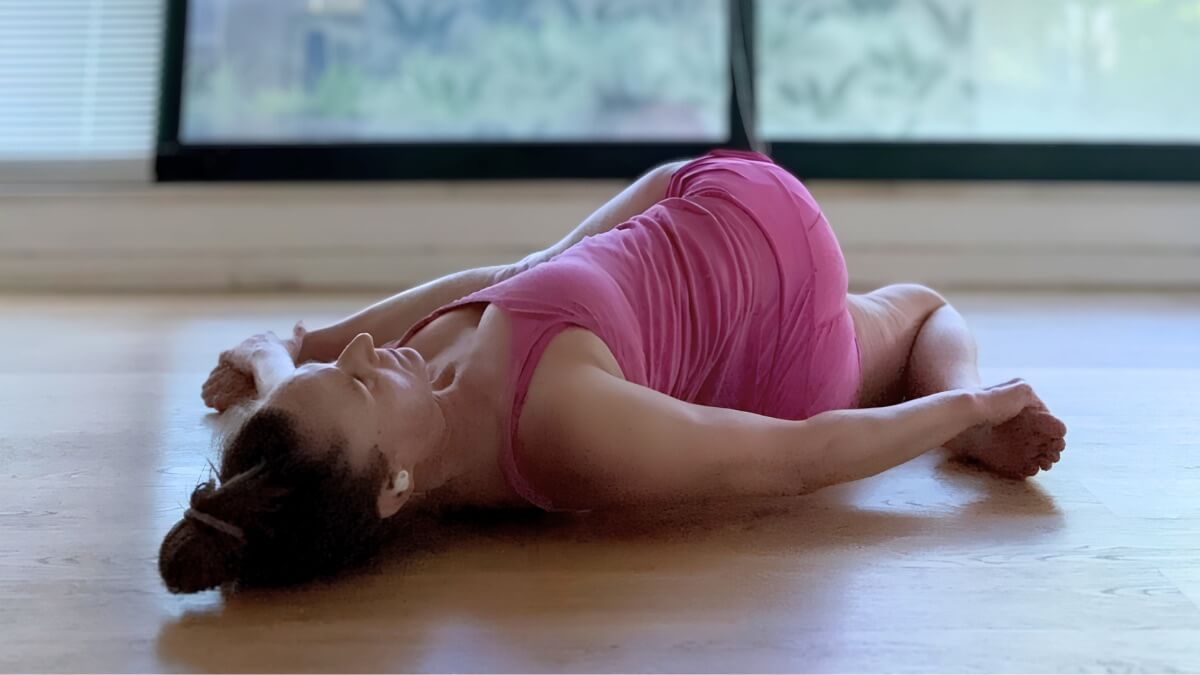
Cat Pulling Its Tail is a reclining Yin Yoga pose that combines a spinal twist with a stretch through the front thigh, hip, and side body. When practiced with one leg extended and the other bent behind the body, the pose may affect the quadriceps, hip flexors, spine, rib cage, outer hip, and shoulder, depending on the variation.
- By: Kevin Parenteau
- Published:
- Reviewed: August 26, 2026
Cat Pulling Its Tail: Overview
Cat Pulling Its Tail is one of the more complex-looking Yin Yoga poses, but it becomes much more manageable when broken down slowly.
At its simplest, the pose combines three actions: one leg extends forward, the other knee bends behind you, and the torso reclines into a twist. Some students hold the back foot with the hand; others use a strap, keep the foot free, or reduce the twist.
The name is playful, but the pose can be strong. Some students feel it mostly through the front thigh and hip of the bent leg. Others notice more sensation through the spine, ribs, side waist, outer hip, or shoulder.
In Yin Yoga, the goal is not to force the deepest version of the pose. The goal is to find an appropriate amount of sensation, support the body where needed, and become still enough to listen.
How to do Cat Pulling Its Tail Pose
- Begin sitting on the floor with both legs extended forward.
- Lean slightly onto your right side and come down onto your right elbow or forearm.
- Bend your left knee and place the left foot on the floor in front of you.
- Allow your torso to begin rotating open as you settle onto your side.
- Bend your right knee, bringing the right foot behind you toward the buttock.
- Reach back with your left hand to hold the right foot or ankle if available.
- If reaching the foot is not comfortable, use a strap around the foot or ankle.
- Allow the chest to rotate open, but do not force the twist.
- Keep the breath steady, and the face relaxed.
- To come out, slowly release the foot, unwind the twist, and rest before changing sides.
Repeat on the second side.
If this setup feels too complicated, simplify it. Practice a side-lying quadriceps stretch or a gentle reclining twist separately before combining the two.
Benefits of Cat Pulling Its Tail
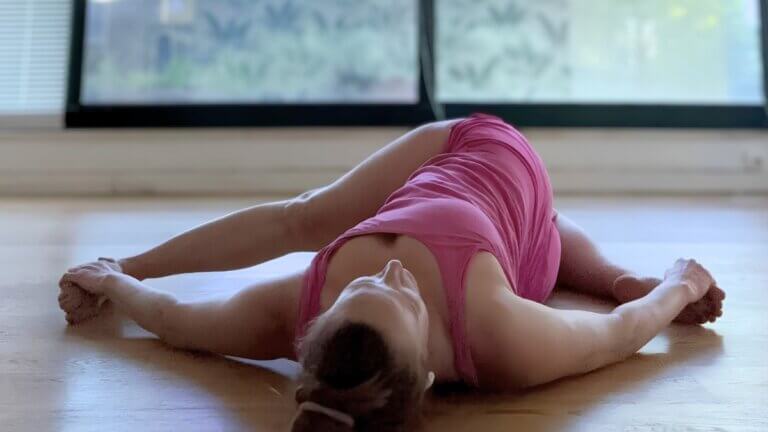
Cat Pulling Its Tail offers a rich combination of sensations because it blends a front-thigh stretch with a spinal twist.
Physical Benefits
- Stretches the quadriceps: Many students feel this pose most clearly through the front thigh of the bent leg.
- Targets the hip flexors: Because the bent leg moves behind the body, the front of the hip may also be affected.
- Encourages spinal rotation: The twist can bring awareness to the spine, ribs, and side body.
- May open the chest and shoulders: Depending on the arm position, the pose may broaden the chest and front shoulder.
- Reveals side-to-side differences: Because the pose is asymmetrical, each side may feel very different.
- Combines several target areas: The pose may affect the thigh, hip, spine, rib cage, and shoulder all at once.
Energetic Benefits: Meridians & Energetic Effects
From a Yin Yoga perspective, Cat Pulling Its Tail may stimulate the Stomach and Spleen meridians through the front thigh and hip when that area is activated.
Because the pose also includes a backbend and twist, it may affect the Urinary Bladder and Kidney lines through the back body. If the twist is felt through the side ribs, some Yin Yoga teachers also associate the pose with the Gall Bladder meridian.
Energetically, twists are often experienced as clarifying or refreshing. Some students also feel a sense of spaciousness through the chest and rib cage.
As always, energetic effects are personal. The experience will depend on your body, your variation, and how the pose is supported.
Contraindications & Safety Tips
Cat Pulling Its Tail is not appropriate for everybody every day.
Modify or avoid this pose if you have:
- Knee pain or limited knee flexion: The bent knee can be strongly loaded in this pose.
- Quadriceps strain or recent thigh injury: Go gently or skip the pose if the front thigh is irritated.
- Low back pain or spinal sensitivity: Reduce twisting and use more support.
- Shoulder pain: Use a strap instead of reaching directly for the foot.
- Hip pain or pinching: Adjust the leg position or choose a gentler variation.
- Pregnancy: Deep reclining twists are usually modified or avoided.
- Recent abdominal, hip, knee, or spinal surgery: Choose a gentler alternative unless cleared by your healthcare provider.
A good rule for this pose: the knee should not feel like the price of admission. If the bent knee feels strained, sharp, or pressured, reduce the quadriceps stretch, use a strap, or choose a simpler variation.
Come out of the pose if you feel sharp, burning, stabbing, electrical, or unsafe sensations.
Pose Modifications & Variations
Cat Pulling Its Tail becomes much more accessible when you use props and choose a smaller version of the pose.
Cat Pulling Its Tail with Props
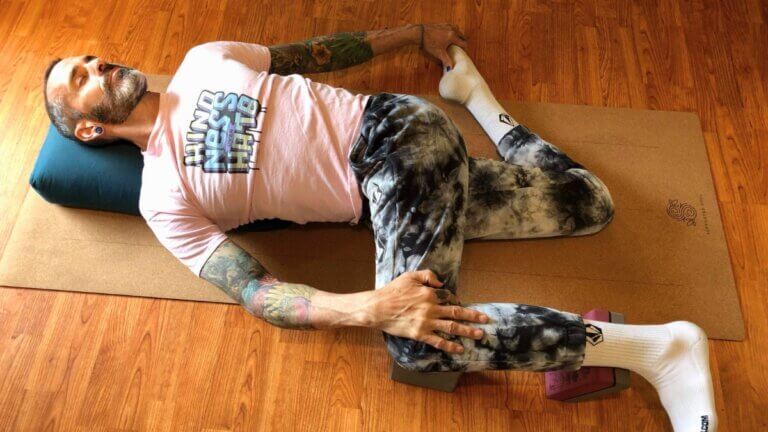
Loop a Yoga strap around the back foot or ankle if reaching the foot directly strains the shoulder, knee, or quadriceps.
A blanket, bolster, or block can support the head if the neck feels unsupported.
A folded blanket or bolster can also be placed under the bent knee if the leg is floating or pulling too strongly.
You can also place support behind the back or ribs if the twist feels too intense and you need something to rest into.
Read 8 Yoga Props That Support Your Yin Practice to learn more.
Beginner-Friendly Variation
Stay propped on your elbow instead of reclining all the way down. This reduces the twist and makes the pose easier to manage.
You can also keep the back foot free instead of holding it. The pose may still create enough sensation through the front thigh, hip, and spine.
Reduced Twist Variation
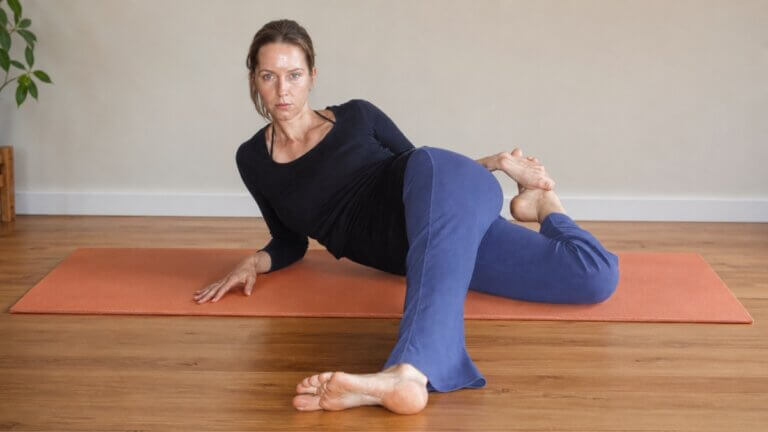
If the twist feels too strong, keep the chest more forward and focus on the thigh stretch. You do not need to open the torso fully for the pose to be useful.
Reduced Quadriceps Stretch
If the bent knee or front thigh feels too intense, allow the foot to move farther away from the buttock, use a longer strap, or release the foot entirely.
Practice the Components Separately
If the full pose feels like too much, separate the parts. Try a side-lying quadriceps stretch first. Then try a gentle reclining twist. Practice each shape separately before combining them.
Muscles, Joints & Target Areas
Cat Pulling Its Tail may affect several areas at once.
Primary target areas:
- Quadriceps
- Hip flexors
- Spine
- Side waist
- Rib cage
- Outer hip
- Chest and shoulder
Common anatomical focus:
- Rectus femoris
- Quadriceps
- Psoas and iliacus
- Spinal rotators
- Thoracic spine
- Lumbar spine
- Rib cage
- Front shoulder
- Hip joint
- Knee joint
Some students feel a strong stretch along the front of the thigh. Others feel the twist more clearly through the spine and ribs. Both experiences are normal.
Beginner Tips for Practicing Cat Pulling Its Tail
- Use a strap from the beginning.
- Keep the twist smaller than you think you need.
- Support the head so the neck can relax.
- Do not force the back foot toward the buttock.
- Let the pose be asymmetrical without trying to make both sides identical.
- Come out slowly.
- Rest between sides.
This is a strong pose for many students. A well-supported variation is usually more useful than the deepest possible version.
How Long Should You Hold Cat Pulling Its Tail?
In Yin Yoga, Cat Pulling Its Tail is commonly held for 1 to 3 minutes per side.
If the pose feels intense, begin with 30 to 60 seconds.
Because this pose combines several actions at once, shorter holds may be more appropriate than in simpler Yin Yoga poses.
When to Practice Cat Pulling Its Tail
Cat Pulling Its Tail is best practiced after the body is warm and prepared.
It works well:
- After gentler twists
- After hip-opening poses
- After poses that prepare the quadriceps and hip flexors
- In the middle or later part of a Yin Yoga sequence
- Before quieter forward folds or rest
Because the pose can be intense, it is usually not the best first pose in a practice.
Counterposes for Cat Pulling Its Tail
After Cat Pulling Its Tail, give the body time to unwind.
Helpful counterposes include:
- Constructive Rest: Lie on your back with the knees bent and feet on the floor.
- Windshield Wiper Knees: Let the knees move side to side gently.
- Knees to Chest: Hug the knees in softly.
- Child’s Pose: Rest forward with support if needed.
- Shavasana: Pause and notice the rebound.
After a strong asymmetrical pose, a simple neutral shape can be the best counterpose.
Related Yin Yoga Poses
If you are exploring Cat Pulling Its Tail, these related Yin Yoga poses may also be useful:
- Reclining Twist — A gentler spinal twist that can help release the back, ribs, and side body without adding the quadriceps stretch.
- Dragon Pose — A lunge-based Yin Yoga pose that targets the hip flexors, groin, and front thigh.
- Saddle Pose — A deeper front-body pose that can affect the quadriceps, hip flexors, and spine.
- Swan Pose — A hip-opening pose that may target the outer hip and glutes, with options to stay upright or fold forward.
- Supported Bridge Pose — A supported backbend that opens the front body while allowing the spine and hips to rest into support.
Cat Pulling Its Tail FAQ
What is Cat Pulling Its Tail in Yin Yoga?
Cat Pulling Its Tail is a reclining Yin Yoga pose that combines a spinal twist with a quadriceps and hip flexor stretch.
What does Cat Pulling Its Tail stretch?
It commonly stretches the quadriceps, hip flexors, side body, and spine. Depending on the variation, it may also affect the outer hip, chest, and shoulders.
Is Cat Pulling Its Tail safe for beginners?
It can be, but beginners should use props and keep the pose smaller. A strap, blanket, or bolster can make the pose much more accessible.
Why does Cat Pulling Its Tail bother my knee?
The bent knee is placed into deep flexion. If the knee feels strained, reduce the intensity of the quadriceps stretch, use a strap, or choose a different pose.
Do I have to hold my foot?
No. You can use a strap, hold the pant leg, or let the foot rest without holding it. Reaching the foot is not required.
Is Cat Pulling Its Tail a twist or a quad stretch?
It is both. Some students feel the twist more, while others feel the front thigh and hip more strongly.
How long should I hold Cat Pulling Its Tail?
Many Yin Yoga students hold the pose for 1 to 3 minutes per side. Shorter holds are fine, especially if the pose feels intense.
What can I do instead of Cat Pulling Its Tail?
Try a side-lying quadriceps stretch, Reclining Twist, Swan Pose, Saddle Pose, or Supported Bridge Pose depending on which area you want to target.
Cat Pulling Its Tail is a powerful Yin Yoga pose because it combines several actions in one shape. The best version is not the deepest version. It is the one that gives you a clear sensation while allowing the body to stay supported, steady, and responsive.
Practice Yin Yoga with us
Join Bernie Clark and Diana Batts for their weekly live online Yin Yoga Classes, or practice with their recordings. Available in the Welcome to the Yinside Subscription.

Kevin Parenteau

You Love Yoga, We Love Yoga—Let’s Stay Connected
Get yoga tips, a little inspiration, and friendly emails—because yoga is better with friends.
🔒 No spam. No selling your data. Ever.