Dangling Pose: Overview
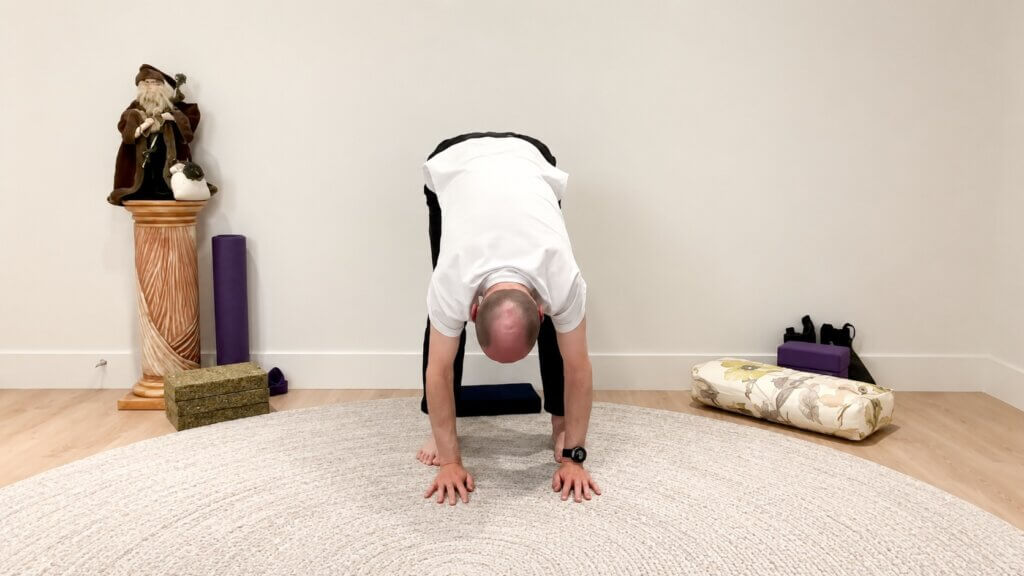
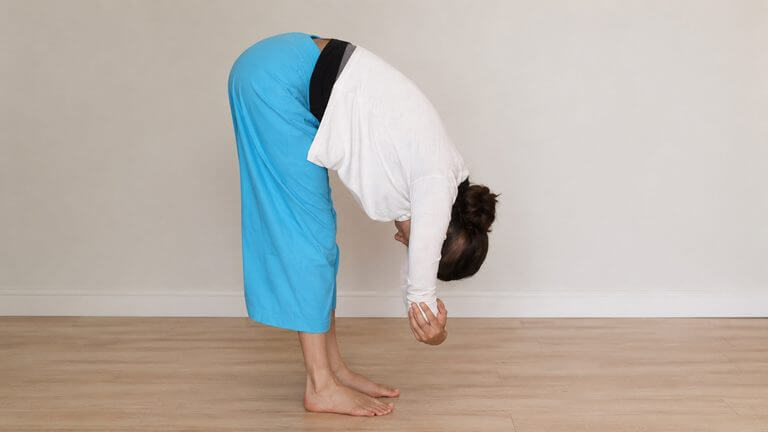
Dangling Pose is the Yin Yoga version of a standing forward fold. The basic shape is simple: stand with the feet about hip-width apart, bend the knees, fold forward, and allow the upper body to hang toward the floor.
What makes Dangling different from a more active standing forward fold such as Uttanasana is the intention. In Yin Yoga, the goal is not necessarily to straighten the legs, reach the floor, or create the biggest possible hamstring stretch. The knees can stay generously bent so the torso can soften toward the thighs and the lower back can round more comfortably.
The amount of knee bend changes the experience considerably. Straighter legs place more emphasis on the hamstrings, while bending the knees reduces some of that tension, asks more of the quadriceps, and may make it easier to release through the lower back.
There is no single correct amount of knee bend for everybody. Your proportions, hamstring mobility, spinal history, balance, and the intention of your practice all matter. Find a position that creates clear but manageable sensation without turning the Pose into a flexibility test.
How to Do Dangling Pose
- Stand with your feet approximately hip-width apart.
- Distribute your weight comfortably between the heels and the front of the feet.
- Bend your knees and begin folding forward from the hips.
- Allow the spine to round as the torso settles toward the thighs.
- Let the head and neck become heavy rather than trying to look forward.
- Hold opposite elbows, clasp the hands, or allow the arms to hang.
- Adjust the knee bend until you can remain in the Pose without straining the hamstrings or lower back.
- Relax unnecessary effort through the shoulders, jaw, and face.
- Stay still, or allow a very gentle sway if that feels natural. Avoid bouncing.
- To come out, bend the knees more and rise slowly. You can also move into Squat Pose before returning to standing.
Take your time coming out. After spending several minutes with the head below the heart, standing up quickly may cause light-headedness for some people.
Benefits of Dangling Pose
Dangling combines a forward fold with an active standing base. Depending on how much the knees are bent, different areas of the body may become more noticeable.
Physical Benefits
- Encourages gentle spinal flexion: Allowing the upper body to hang can create a gentle stretch through tissues along the lower and middle back.
- Stretches the back of the legs: With the knees closer to straight, the hamstrings and other tissues along the backs of the legs are generally more involved.
- Strengthens the thighs when the knees bend: A deeper knee bend reduces hamstring demand but requires more quadriceps work to support the body.
- Allows the upper body to relax: The shoulders, neck, arms, and head can become relatively passive while the legs provide support.
- Creates abdominal compression: Bringing the torso toward the thighs gently compresses the abdomen, particularly when the knees are deeply bent.
- Explores the relationship between hips and spine: Changing the knee bend can help you notice how hamstring tension, hip movement, and spinal flexion affect one another.
Energetic Benefits: Meridians & Energetic Effects
Within the traditional Yin Yoga and Traditional Chinese Medicine framework, Dangling is most commonly associated with the Urinary Bladder meridian due to the stretch along the backs of the legs and spine.
The Pose is also traditionally discussed in relation to the Liver, Spleen, and Kidney energetic systems.
How strongly any particular area is affected depends on the variation. Someone practicing with relatively straight legs may experience the backs of the legs more intensely. At the same time, a practitioner with deeply bent knees may notice greater sensation in the lower back and thighs.
As with all energetic interpretations of Yoga postures, individual experience varies. The aim is not to manufacture a particular sensation, but to observe what arises in the version of the Pose that suits your body.
Contraindications & Safety Tips
Dangling places the head below the heart and the spine into flexion, so it is not appropriate for everybody in the same way.
Modify or avoid the Pose when appropriate if you have:
- High blood pressure or a condition where head-below-heart positions have been restricted: Ask your healthcare provider whether this type of forward fold is appropriate for you.
- A tendency toward dizziness or low blood pressure: Come out very slowly, or move from Dangling into Squat Pose before standing upright.
- Glaucoma or another condition affected by increased pressure in the head or eyes: Follow the guidance of your healthcare provider regarding head-below-heart positions.
- Lower-back pain or spinal sensitivity: Bend the knees more and consider supporting the torso or elbows. If spinal flexion has specifically been restricted for you, keep the back more neutral rather than rounding deeply.
- Balance difficulties: Practice near a wall, chair, or sturdy table so support is readily available.
The sensation should remain manageable. Come out if you experience sharp pain, burning, electrical sensations, numbness, significant dizziness, or anything that feels unsafe.
There is also no requirement to straighten the knees. If straightening the legs creates excessive pulling through the hamstrings or causes the lower back to feel strained, bend them.
Dangling Pose Modifications & Variations
A small change in knee position or support can make Dangling feel like a very different pose. Use the variation that best serves the area you want to explore.
Bend the Knees More
For many Yin Yoga students, this is the most useful version of Dangling.
Bending the knees reduces the demand on the hamstrings and allows the torso to move closer to the thighs. This may make it easier to relax and round through the lower back.
A deeper knee bend also makes the quadriceps work harder. If your thighs fatigue quickly, shorten the hold or alternate Dangling with Squat Pose.
Use Straighter Legs
If your hamstrings tolerate the position comfortably, gradually straightening the legs increases the stretch along the back of the thighs.
The legs do not need to become completely straight. Keep enough softness in the knees that you can remain relaxed through the upper body without forcing the fold.
This variation shifts the emphasis toward the hamstrings so that it may feel considerably different from the deeply bent-knee version.
Rest the Elbows on the Thighs
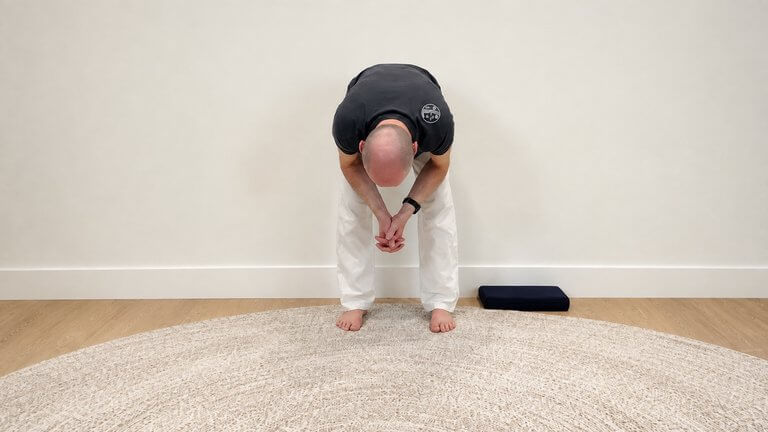
If hanging freely places too much demand on the lower back, bend the knees and rest the elbows or forearms on the thighs.
This gives the torso additional support while preserving the basic forward-folding shape.
You can gradually remove some of the support if the back begins to feel comfortable, but there is no requirement to progress to the unsupported version.
Use a Chair or Table for Support
A sturdy chair or table can provide even more support. Fold forward and place the hands or forearms on the support rather than allowing the torso to hang completely.
This is useful when balance is a concern or when the unsupported version produces excessive sensation in the lower back or hamstrings.
Hold the Wrists or Elbows
The traditional relaxed-arm position is to hold opposite elbows and allow the arms to hang beneath the shoulders.
If you are very flexible, holding the wrists behind the legs can increase the fold, but depth is not the objective. Maintain enough rounding and softness that the Pose still feels like a Yin practice rather than an attempt to pull yourself farther forward.
Use Caterpillar Pose Instead
If standing is uncomfortable, balance is a concern, or the legs fatigue quickly, Caterpillar Pose offers a seated alternative.
Caterpillar allows you to explore spinal flexion and the back body without supporting your body weight through the legs.
Muscles, Joints & Target Areas
Dangling is often described as a lower-back pose, but what you feel depends heavily on how you organize the legs.
Primary target areas may include:
- Lower and middle back
- Hamstrings
- Calves
- Quadriceps
- Back-body tissues
- Spine
- Hips
- Knees
With straighter legs, the hamstrings usually become more prominent. Tightness in the backs of the thighs can limit how far the pelvis tips forward, which may change the amount of movement through the spine.
Bending the knees changes that relationship. The hamstrings are placed under less tension, the quadriceps become more active, and the torso may settle closer to the thighs.
This is one reason the same Pose can look—and feel—quite different from person to person. Someone with long hamstrings may comfortably practice with relatively straight legs, while another practitioner may need a substantial knee bend to find an appropriate lower-back release.
The goal is not to make the Pose look a particular way. Use the knee position that creates the intended sensation without asking another area of the body to pay for it.
Beginner Tips for Dangling Pose
- Start with more knee bend than you think you need.
- Let the head and neck relax rather than holding the head up.
- Keep the feet grounded and distribute your weight comfortably.
- Do not bounce to deepen the forward fold.
- Use a chair, table, or thighs for support if the back feels strained.
- Do not worry about reaching the floor.
- Shorten the hold if the thighs fatigue.
- Come out slowly, especially if you are prone to light-headedness.
Dangling is visually simple, which can make it tempting to think that a deeper fold must be better. It is not. A modest forward fold with bent knees may be far more useful than a straight-legged, strained back.
How Long Should You Hold Dangling Pose?
Dangling is often held for approximately 1 to 3 minutes.
Three minutes can feel surprisingly intense because the legs are still working even while the upper body is encouraged to relax. Beginners may prefer to start with 30 to 60 seconds and gradually increase the time.
Another option is to practice several shorter rounds. Dangling can be alternated with Squat Pose, giving the body a different shape between forward folds.
As always in Yin Yoga, a longer hold is not automatically better. Stay long enough to explore the Pose without losing the ability to respond to what your body is telling you.
When to Practice Dangling Pose
Dangling can work well in several places within a Yin Yoga practice.
You might use it:
- Near the beginning of a practice to explore the back body
- Between standing poses
- Before or after Squat Pose
- Before moving into seated forward folds
- As a transition from standing into floor-based poses
Because the legs remain active, Dangling can also provide a useful contrast to more passive floor poses.
Counterposes for Dangling Pose
After spending time in spinal flexion, come out gradually and notice how the back and legs feel before immediately moving into another strong posture.
Useful counterposes include:
- Squat Pose: A natural transition from Dangling that keeps you low to the ground while changing the position of the hips, knees, and spine.
- Gentle standing extension: Once upright, place your hands at your hips or lower back and gently lift your chest if that feels comfortable.
- Child’s Pose: A quieter floor-based option if you want to rest before continuing.
- Sphinx Pose: A gentle spinal extension that may work well later in the sequence after several forward-bending poses.
- Constructive Rest: Lie on your back with the knees bent and pause long enough to notice the rebound from the Pose.
The counterpose does not need to be dramatic. Sometimes a neutral position and a little time are enough.
Related Yin Yoga Poses
If you are exploring Dangling Pose, these Yin Yoga poses offer related ways to work with the spine, hamstrings, hips, and back body:
- Caterpillar Pose: A seated forward fold that allows the legs and torso to be supported by the floor rather than requiring the thighs to remain active.
- Squat Pose: Frequently paired with Dangling and useful as a transition between rounds.
- Sphinx Pose: A prone backbend that introduces spinal extension after forward-folding work.
Dangling Pose FAQ
What is Dangling Pose in Yin Yoga?
Dangling is a standing Yin Yoga forward fold. The knees are usually bent to some degree while the torso, head, and arms relax toward the floor.
Is Dangling Pose the same as Uttanasana?
The shapes are related, but their intentions are often different. In a Yin version of the Pose, there is less emphasis on straightening the legs or maximizing the hamstring stretch and more emphasis on allowing the lower back and upper body to release.
Should my knees be bent in Dangling Pose?
They can be. Bending the knees reduces some hamstring tension, increases the work required of the quadriceps, and may allow the lower back to relax more fully.
Some people also practice with straighter legs when they want more emphasis on the hamstrings. There is no universal knee position that is right for everybody.
Why do my thighs work so hard in Dangling?
When the knees are bent, the quadriceps must help support your body weight. A deep knee bend can therefore become tiring even though the upper body is relatively relaxed.
If the thighs become fatigued, reduce the knee bend, shorten the hold, or come into Squat Pose before returning to Dangling.
Why do I feel Dangling more in my hamstrings than my back?
Straighter legs increase tension through the hamstrings. Try bending the knees more and bringing the torso closer to the thighs. This often reduces the emphasis on the hamstrings and changes the sensation through the back.
Why do I feel dizzy after Dangling Pose?
The head remains below the heart during the Pose, and some people become light-headed when they return to standing too quickly. Bend the knees and come up gradually, or transition into Squat Pose first.
If dizziness is frequent, severe, or associated with a medical condition, discuss head-below-heart postures with your healthcare provider.
How long should I hold Dangling Pose?
Many Yin Yoga practitioners stay for approximately 1 to 3 minutes. Beginners can start with 30 to 60 seconds. Several shorter rounds are also an option.
Can beginners practice Dangling Pose?
Yes, provided the Pose is appropriate for them. Beginners can bend the knees generously and use the thighs, a chair, or a table for support. There is no requirement to touch the floor or straighten the legs.
Can I watch Bernie Clark demonstrate Dangling Pose?
Yes. Watch Bernie Clark demonstrate Dangling Pose on the Asana at Home YouTube channel.
Dangling Pose is uncomplicated, but that simplicity leaves plenty to explore. A small change in knee bend can shift the experience from the hamstrings toward the thighs and lower back, while added support can make the Pose accessible when hanging freely is too strong.
The useful version is not necessarily the deepest one. Bend the knees when you need to, let the upper body become heavy, and choose the variation that creates an appropriate amount of sensation for your body today.
Practice Yoga With Us
Explore Yin, Hatha, and Chair Yoga classes inside Welcome to the Yinside.